What it would take to bring AI literacy to Mauritania — and why the tea ceremony is not a metaphor
The First Glass
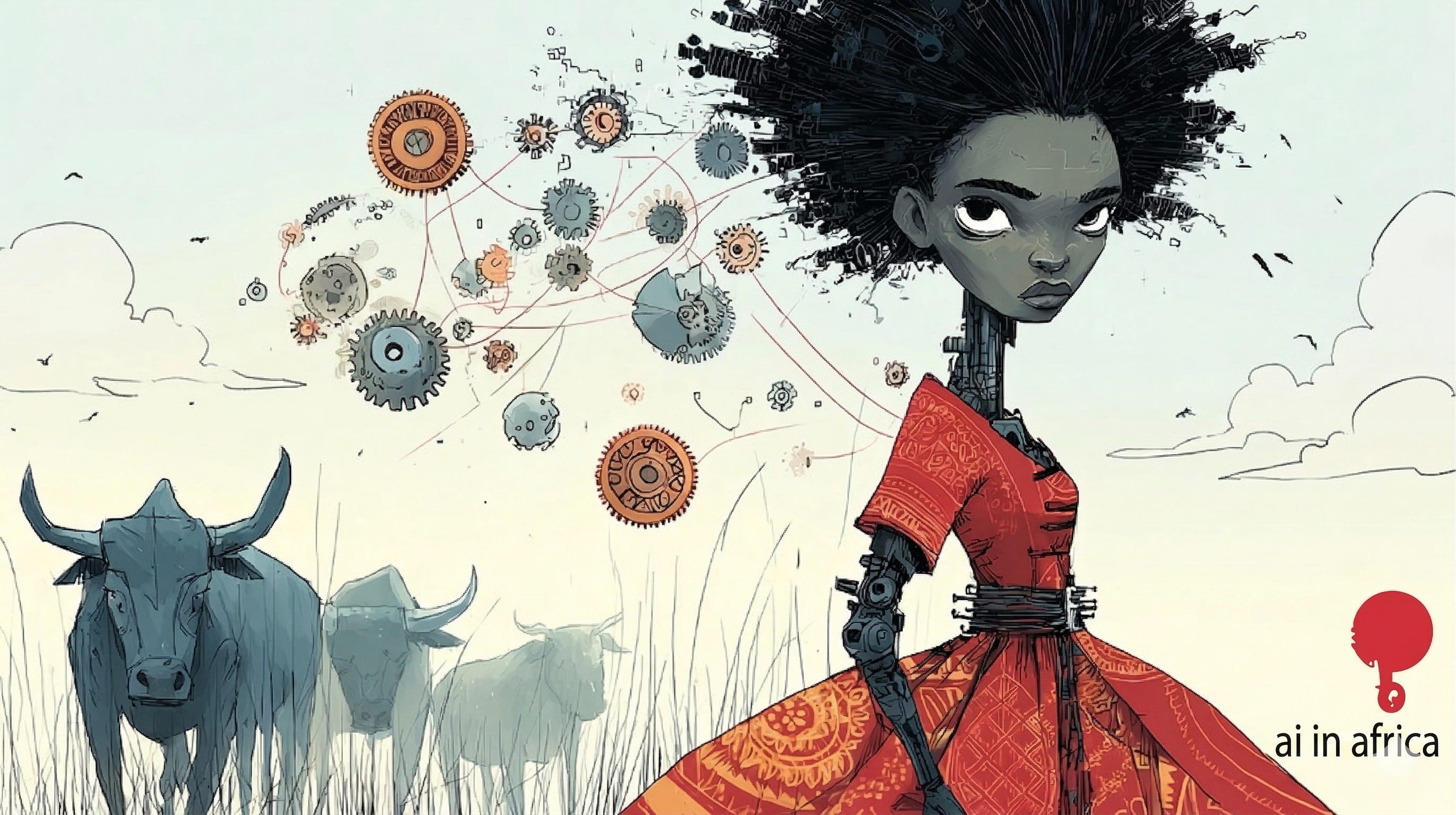
You are a construction laborer in Nouakchott’s Arafat district. You have worked for the same contractor for four years — concrete, painting, scaffolding, the kind of work that leaves marks on your body but none on paper. You need a letter. Not a complicated letter. A letter that says: this man worked here, for this long, doing this work. A letter that would help you get an identity card, which would help you get a bank account, which would help you do anything that the formal economy requires of a person before it agrees to see them.
You cannot write the letter. Not because you lack the knowledge of what it should say. You know exactly what it should say. You cannot write it because no one ever taught you to make the marks, and because the marks required are in French — a language you do not speak — addressed to an administration that will not accept anything less than formal register, correct orthography, proper salutation.
There is a word for this situation. It is not illiteracy. It is exclusion by documentation architecture.
The Specific Problem of Mauritania
Every West African country has a version of this problem. Mauritania’s version is structurally distinct in ways that matter for anyone thinking seriously about deploying an AI literacy tool here.
The ATTAYA audit makes the distinction precise. Most Francophone West Africa deployments face a literacy gap — a portion of the population that hasn’t learned to read in any script. Mauritania faces something different: a population that is significantly literate, but literate in the wrong script for the administrative system that governs their lives.
The mahadra boarding school system — the dominant rural education institution in Mauritania — produces graduates who can read and write Arabic fluently, who have memorized substantial classical texts, who are trained in dictation, recitation, and the careful supervision of written language. These are not non-literate people. They are people whose literacy is invisible to the French-medium administrative economy. Khadijatou mint Yahya, the mahadra teacher in Néma, has been educating students for decades. She runs a tontine, manages cooperative records, administers an institution that has existed for nearly a century. She cannot fill out a French government form unassisted. The French administration cannot see her competence because it only recognizes competence in one script.
This is the problem Botspeak + Claude could solve, if deployed correctly. It could function as a translation layer between the mahadra tradition and the French administrative system — not by teaching Khadijatou to write French, but by giving her a system she can direct in Hassaniya to produce French documents she then supervises for accuracy.
That is a real capability that exists right now. Getting it to work in Mauritania requires confronting three obstacles that have no equivalent in Ghana or Guinea.
Obstacle One: The Hassaniya Void
The primary spoken language of approximately seventy to eighty percent of the Mauritanian population is Hassaniya Arabic. It is not Modern Standard Arabic. It is not Gulf Arabic. It is a dialect with Maghrebi and Berber influences, a distinct phonological profile, and a vocabulary that diverges sharply from the MSA that dominates Arabic NLP training data.
There is no production-quality ASR for Hassaniya. No corpus at scale. No commercial system that has been evaluated against Hassaniya speech in published research. When a global ASR model encounters Hassaniya, it does what global ASR models do with unfamiliar input: it produces its best guess in the closest language it knows, which is MSA. The output is confident, fluent, and wrong.
This failure mode is uniquely destructive in a literacy acquisition context. A literate user encountering an ASR error can read the output and catch the mistake. A non-literate user hearing a read-back of MSA text that does not represent what they said has no detection mechanism. The AI has become an authoritative misrepresenter of their intent, and they cannot know it.
This means the standard voice-first deployment architecture — voice in, Claude generates, TTS reads back — does not work in Mauritania today. The voice-in component has no viable infrastructure. The ATTAYA audit names what this actually requires: a corpus-build prerequisite before a voice feature can be honestly scoped. Five hundred hours of transcribed Hassaniya speech, across dialect regions, across domains, across age cohorts and genders and urban and nomadic speakers. The institutions that might anchor this work — Université de Nouakchott, the Institut Mauritanien de Recherche Scientifique, ISERI — exist, but their capacity and willingness require direct engagement before anything else can be planned.
This is not a problem you engineer around. It is a problem you build through, slowly, with in-country partners who understand what the corpus needs to contain. Until you have it, the viable architecture is human-mediated: a mahadra-educated intermediary listens to the user’s Hassaniya oral prompt, types it as an MSA Arabic text prompt, and reads Claude’s output back in Hassaniya. That architecture is available today. It is not ideal. It is what exists.
The cultural framing for this architecture is not a workaround. In mahadra tradition, the sheikh dictates and the student transcribes. The student is not substituting for the sheikh’s composition — the student is the instrument through which the sheikh’s knowledge becomes written. Framing Claude as “a fast scribe who knows formal Arabic and French” is both accurate and coherent within a tradition the target population already inhabits.
Obstacle Two: The Architecture Nobody Fixes After Launch
The second obstacle is RTL. Right-to-left interface architecture.
This sounds like a localization detail. It is not. RTL affects navigation direction, layout flow, input fields, reading order, icon directionality, punctuation placement, number positioning in mixed-script contexts, and the design logic of every screen a user will encounter. A product built LTR and retrofitted to RTL produces an interface that malfunctions in ways that are obvious to any Arabic-script literate user and invisible to any developer who tested the product in English.
For Mauritania, RTL is not a feature for a subset of users. It is the default requirement for the majority of users. The mahadra graduate who is the target literate intermediary for this deployment reads right-to-left. The Arabic-script output that Claude produces reads right-to-left. Any screen that displays both French text (LTR) and Arabic text (RTL) in the same interface has a bidirectional text rendering challenge that must be designed from the beginning, not patched afterward.
The ATTAYA audit specifies this as a first-order architectural requirement: establish RTL-first interface architecture before writing a single line of product code. This is the kind of requirement that disappears into a backlog when deployment teams are excited about the core AI capability and impatient to ship. It is also the kind of requirement whose absence becomes apparent to every Arabic-literate user within the first thirty seconds of using the product.
Obstacle Three: The Heat
Mauritania’s Saharan climate produces ambient temperatures of forty-five to fifty degrees Celsius during hot season. This is not a comfort issue. It is a device engineering boundary.
At forty-five degrees ambient, a low-cost Android device — the Tecno or Itel handsets that are the actual deployment runtime for this population — will begin thermal throttling within minutes of sustained screen-on use. At fifty degrees in direct sunlight, forced device shutdown is a realistic outcome within ten to fifteen minutes. Battery degradation at these temperatures is permanent. A device that has spent a Mauritanian summer in Saharan conditions will have permanently reduced capacity by autumn.
The ATTAYA audit derives a specific design requirement from this: all critical Botspeak interaction paths must complete in under ninety seconds. A user in Hodh Ech Chargui sitting outside a mahadra in July cannot sustain a four-minute iterative refinement session. The session must be designed to produce value within ninety seconds, with state checkpointing at every step so that a thermal shutdown does not destroy the user’s progress.
This constraint sits in direct tension with the other cultural design requirement. The attaya ceremony — the three-glass tea ritual that gives the ATTAYA framework its name — is the pacing principle for all human relationship-building in Mauritanian culture. You do not open a meeting by asking for something. You do not begin a business relationship with a form. You offer tea, you establish presence, you allow time. The first glass is bitter and slow. The relationship is the prerequisite for everything else.
A product that opens with a registration prompt has refused the first glass. It will not recover.
Resolving the tension between attaya pacing and ninety-second thermal sessions requires design intelligence: a brief but genuine greeting sequence (fifteen to twenty seconds), a useful productive interaction, state-checkpointed so the session can be resumed across multiple short encounters rather than completed in one continuous push. The relationship can breathe across time. The individual session cannot.
What a Pilot Would Actually Look Like
A Mauritania Botspeak pilot that takes the ATTAYA analysis seriously looks nothing like a standard product launch.
It begins with six months of in-country engagement before any product is built. ANPDP registration — Mauritania’s data protection authority under Loi 2022-19 — is an approval process, not a notification. Voice recordings are almost certainly biometric data under the law’s provisions, which means separate authorization, heightened protection requirements, and explicit consent architecture that works for users who cannot read a consent form. The consent must be delivered as recorded Hassaniya audio. Affirmative oral response is the consent signal. This is not an edge case accommodation — it is the primary consent architecture for the majority of the target population.
ARPT authorization for USSD short codes takes four to twelve weeks. The product cannot go live on USSD before that authorization exists. Orange Money Mauritanie’s API requires verification against BCM’s current PSP framework — which is explicitly not the BCEAO framework that governs Senegal, Benin, or any WAEMU member state. Every financial architecture assumption borrowed from a Francophone West Africa deployment must be discarded and rebuilt from Mauritanian regulation.
The Haratine KYC problem must be solved in version one, not deferred to a roadmap. The Haratine community — historically enslaved, currently facing documented civil registration gaps — cannot be assumed to have government-issued biometric ID. If Botspeak’s deployment requires a national identity card to unlock functionality, it has architecturally excluded an estimated forty percent of the population before it has served a single user. The fallback design options are concrete: community vouching through a sheikh, cooperative registration that substitutes institutional ID for individual ID, limited-functionality access without documentation. SOS Esclaves — the Mauritanian anti-slavery NGO — and IOM Mauritanie both have active civil registration programs. Direct partnership for a registration-support pathway is available if the deployment team pursues it.
The pilot itself — when it begins — runs three tracks simultaneously. In Nouakchott, a literate intermediary model with mahadra graduates serving as prompt operators and community scribes, testing the urban professional case for Arabic-script-literate users who need to navigate French administration. In the Senegal River valley corridor — Rosso, Trarza — a Pulaar-interface variant using NLP infrastructure available from the TERANGA framework, with Tijaniyya Dahira endorsement as the trust mechanism. In Néma, Hodh Ech Chargui, a sheikh-endorsed mahadra community model, with community listening sessions substituting for individual critical reading, and the sheikh’s implicit authorization functioning as the product’s trust credential in the region.
These three tracks are not the same product with different language layers. They are different deployment architectures responding to different social trust structures, different connectivity realities, and different literacy profiles. Treating them as identical is the mistake that produces deployment failures that look like low demand.
What Anthropic’s Education Initiative Would Need to Understand
The Mauritania case makes a different argument to Anthropic than Ghana or Guinea does.
In Ghana, the argument is about the north-south literacy gap — a population with acute documentation needs that a text-first interface excludes by design. In Guinea, the argument is about the Susu void and the political risk of operating under a military transition government.
In Mauritania, the argument is about a population that is highly educated and completely excluded — not because they cannot learn, but because their learning happened in the wrong script for the administrative system that now governs their economic lives. The mahadra tradition produced people who can memorize, analyze, dictate, and supervise text with sophistication. It did not produce people who can navigate the French administrative apparatus. That gap is the product opportunity.
Claude for Education, as currently designed, imagines a university student who reads English fluently, has institutional access, and needs help thinking through an essay or understanding a concept. That student exists in Mauritania — in Nouakchott, at the Université de Mauritanie, among the French-educated urban professional class. That student is also approximately fifteen percent of the country.
The other eighty-five percent includes Khadijatou, who runs a mahadra and cannot write to the Ministry of Education in the language the Ministry requires. It includes Bilal, who worked in construction for four years and cannot produce the documentation that would let him exist in the formal economy. It includes the tontine groups, the cooperative secretaries, the agricultural communities of Hodh Ech Chargui whose knowledge of their own land and their own livestock is sophisticated and entirely undocumented because documentation requires French.
An education initiative that understood this would not necessarily need to build different AI. It would need to fund different deployment infrastructure: the Hassaniya corpus collection that is the prerequisite for voice features, the RTL architecture that makes the interface legible to the actual users, the in-country regulatory engagement that cannot be done remotely, the community endorsement processes that take months and cannot be compressed.
It would need to accept that success in this context is not measured in monthly active users. It is measured in letters to government ministries that were previously impossible to write. In cooperative records that now exist. In Bilal’s identity card application, which could not have happened without a document that Claude helped him produce in formal Arabic.
The Tea Ceremony Is the Architecture
The attaya ceremony is not a metaphor that the ATTAYA framework uses to make a cultural point. It is a functional specification for how trust works in Mauritanian communities, and therefore for how a technology must behave if it wants to be trusted.
The first glass is bitter. It is the glass of presence — of showing up without agenda, of being willing to sit and wait and not demand anything. A product that opens with a registration form has skipped the first glass. It has said, before the relationship exists, that it is here for what it can extract.
The second glass is sweet. This is the working relationship — the exchange that becomes possible after trust has been established. This is the Botspeak session where Bilal’s employment letter gets produced, where Khadijatou’s funding request goes to the Ministry in the language the Ministry requires.
The third glass is gentle. This is the deepening — the point at which the tool has demonstrated its value consistently enough that the community begins to rely on it, to teach it to each other, to expect it to be there.
You cannot rush to the second glass without the first. You cannot get to the third without the second. A product that optimizes for transaction volume and tries to skip the opening sequence will never reach the users who most need it, because those users have spent their lives watching institutions appear with forms and leave with data and provide nothing in return.
The apprentice who doesn’t sleep — Claude, available at any hour, producing formal documents at the direction of users who know what they need to say — is a powerful capability. In Mauritania, whether it reaches the people who need it most depends entirely on whether the deployment team is willing to sit down, accept the first glass, and wait for the relationship to begin.
That is the requirement. It is not technical. It is not regulatory. It is whether Anthropic’s education initiative is willing to work at the pace of trust.
Framework analysis: ATTAYA — Mauritania AI Adaptation Consulting MoctarDatt.com